
MD_PERELIGYN — Holistic & Integrative Medicine — Dr. Vladimir Pereligyn
Ways to Work Together
Four formats — from a lab review to a full month of supervision. Card payment (EUR), works from most countries.
Lab Review
€100
Review of your lab results with prescriptions based on them.
- Written summary of your lab results
- Prescription list
- Recommendations for further testing
Consultation + Follow-up Review
€250
Full review → prescriptions → follow-up review → recommendations.
- Full review of your condition and labs
- Prescription list
- Follow-up review of control labs
- Final recommendations
2-Week Support
€500
Two weeks of work with the team + a nutritionist on board.
- Everything in Consultation + Follow-up Review
- Two weeks of active supervision
- Nutritionist consultation and guidance
- Plan adjustments along the way
VIP — Full Month
€1,000
30 days of full supervision: doctor, nutritionist, and specialist consultations arranged for you.
- Intake form and electronic medical record
- Clinical assessment and lab test list
- Health map and root-cause identification
- Personalized treatment plan and prescription list
VIP — Full Month — €1,000
Online payment will be available soon. Message us on WhatsApp to book your consultation.
Ask a Question




Health Shop
Detailed Treatment Programs
Personalized recovery protocols for complex medical conditions
Diabetes Treatment
Comprehensive treatment for type 1 and type 2 diabetes
Burnout Treatment
Comprehensive recovery from emotional and physical exhaustion
Anti-aging Program
Slowing aging processes and optimizing longevity

Medical Tourism
News and Articles
Current materials on health, holistic medicine and my programs
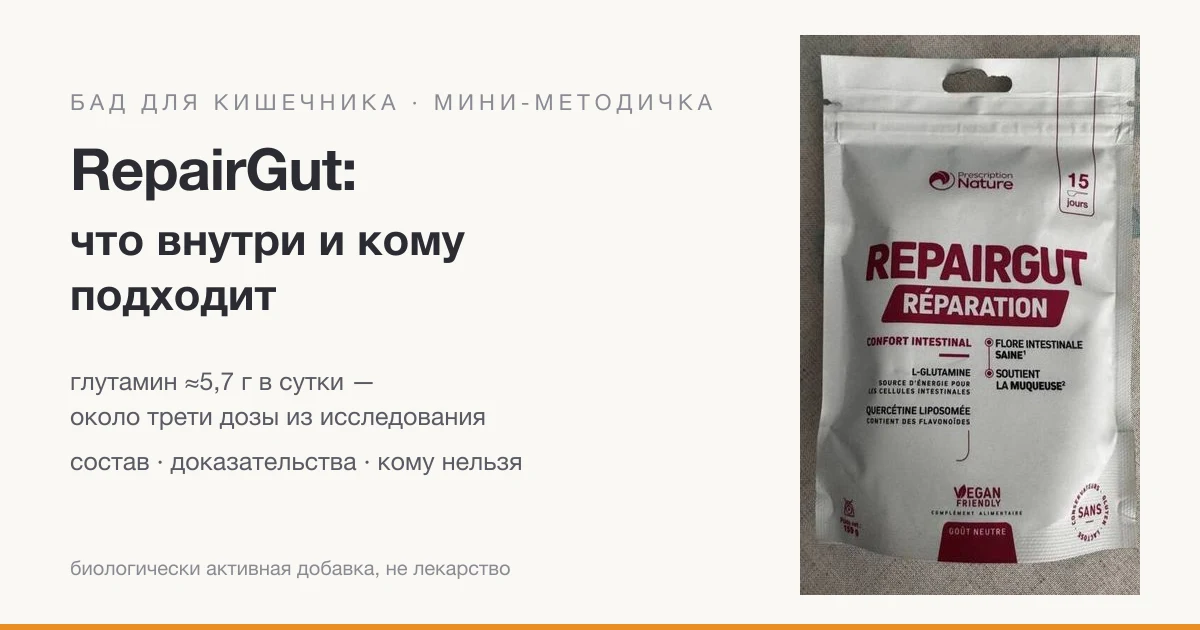
RepairGut: what is inside and who it suits
A mini-guide to the RepairGut supplement (Prescription Nature, France): what is in the daily serving, at what doses and in what forms each ingredient was studied, what these data cannot yet tell us and who the product does not suit.
October 4, 2026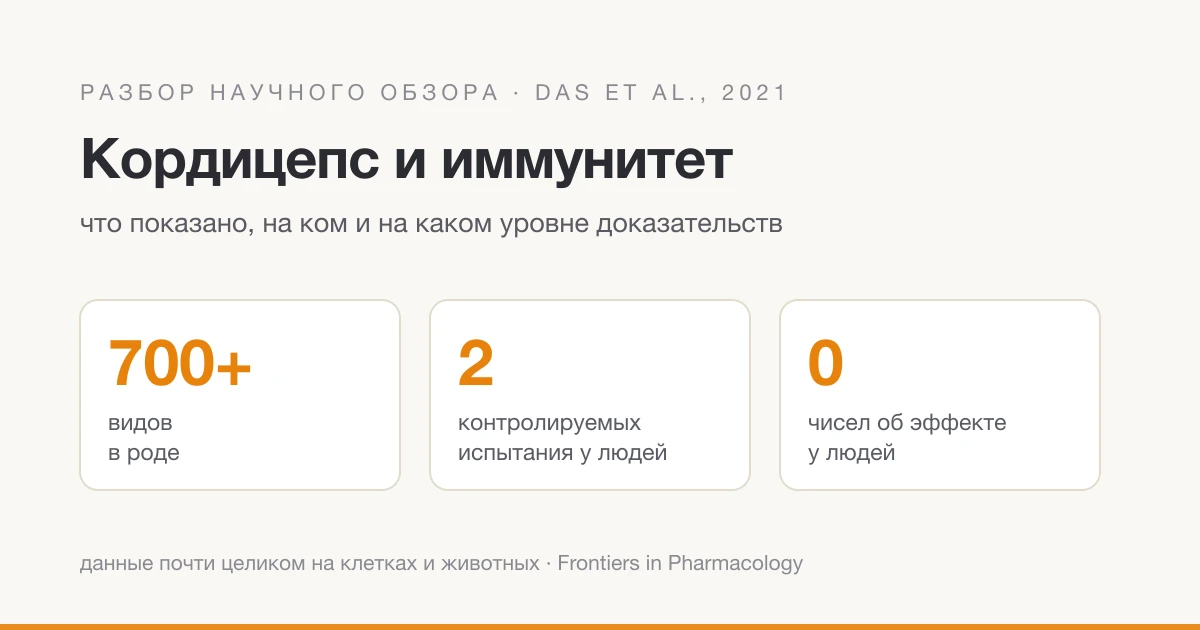
Cordyceps and immunity: a review of Das et al., 2021
A review of Das et al. (Frontiers in Pharmacology, 2021): which effects of cordyceps are described, where they were observed (in a test tube, in animals or in humans), and what the review does not show.
October 3, 2026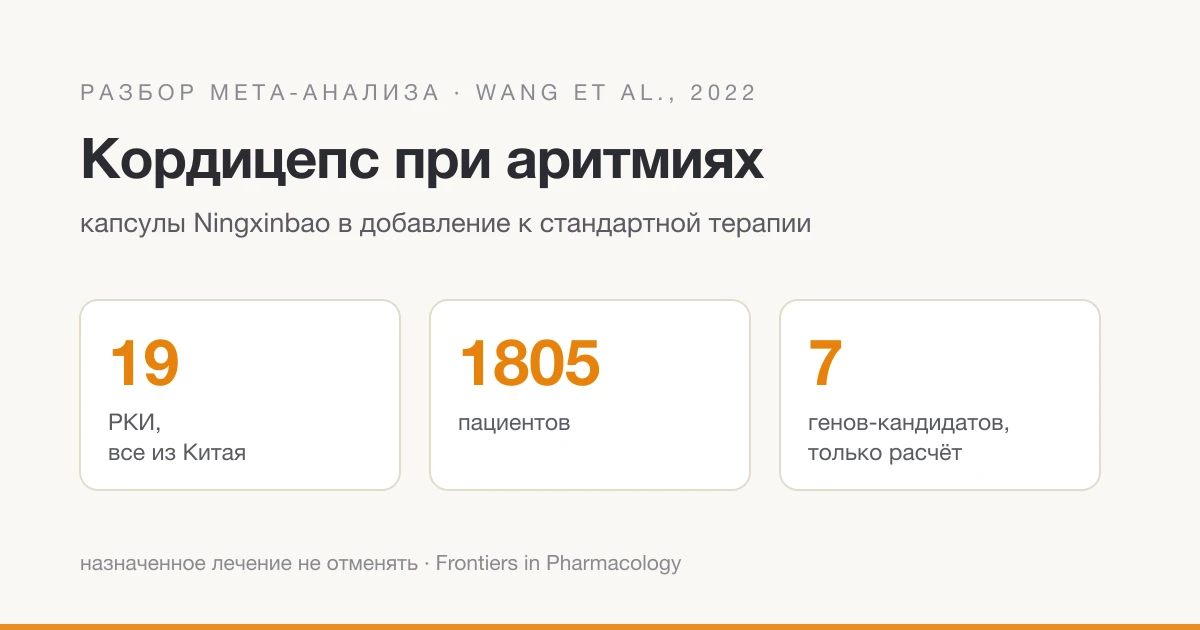
Cordyceps and Arrhythmias: A Review of Wang et al., 2022
A meta-analysis of 19 Chinese RCTs showed a signal of benefit from Ningxinbao capsules as an add-on to arrhythmia treatment — with an undisclosed criterion of success and no data on mortality, strokes, or hospitalizations. The mechanism was derived by calculation only. What the article shows, at what level of evidence, and what it does not show.
October 3, 2026
Modafinil: mechanism, indications and comparison with other wake-promoting agents
A review of modafinil based on labels from the FDA, EMA and other regulators and on research: what is known about the mechanism (officially it is unknown), duration of action, indications in the US, EU, UK, Switzerland, Japan, Canada, Australia and South Korea, efficacy in RCTs, off-label use, comparison with armodafinil, caffeine, stimulants, solriamfetol, pitolisant and oxybate, interaction with hormonal contraception, pregnancy and safety.
October 2, 2026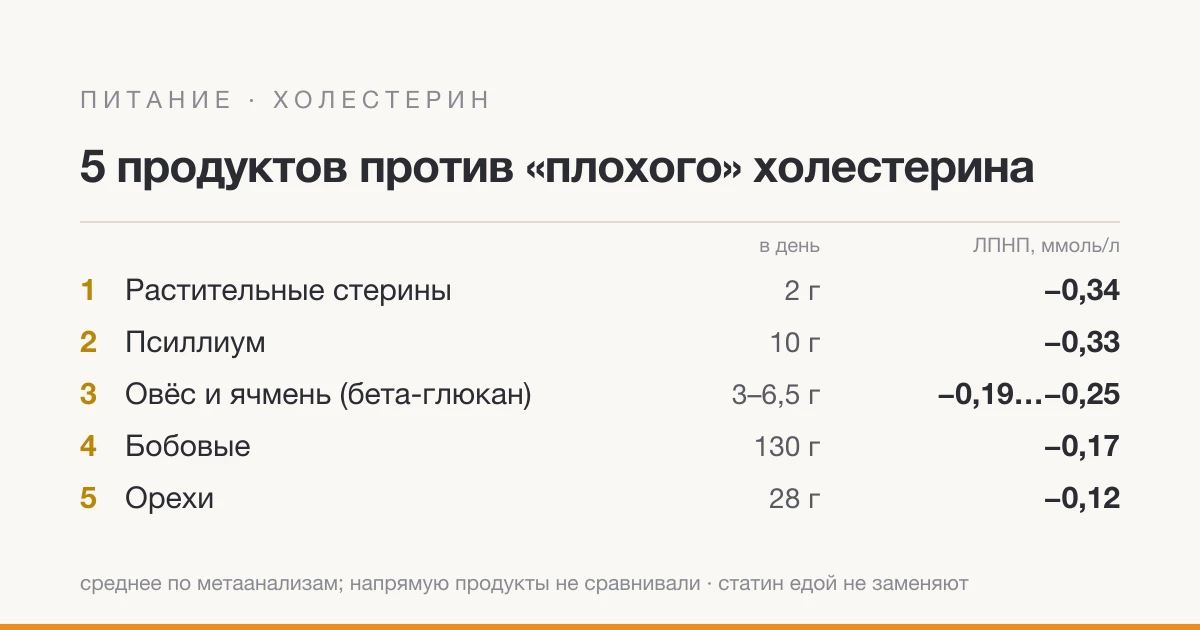
5 foods that lower bad cholesterol: how much to eat and how far LDL falls
Five foods that lower "bad" cholesterol in meta-analyses — LDL cholesterol (low-density lipoprotein): daily amounts, figures in mmol/L and mg/dL, and honest caveats. Why the places are provisional, what is known about heart attacks, who foods with added sterols may not suit, and why food does not replace a prescribed statin.
October 1, 2026
Iron and thyroid pills: why 4 hours, and when to check ferritin
One person can take a thyroid pill and iron if the two are separated in time — though even the gap does not help everyone. We look at where the 4 hours came from and why some leaflets say 2, what a small study of taking them together showed, why iron is not stopped when there is a deficiency, and when it is worth checking ferritin.
September 24, 2026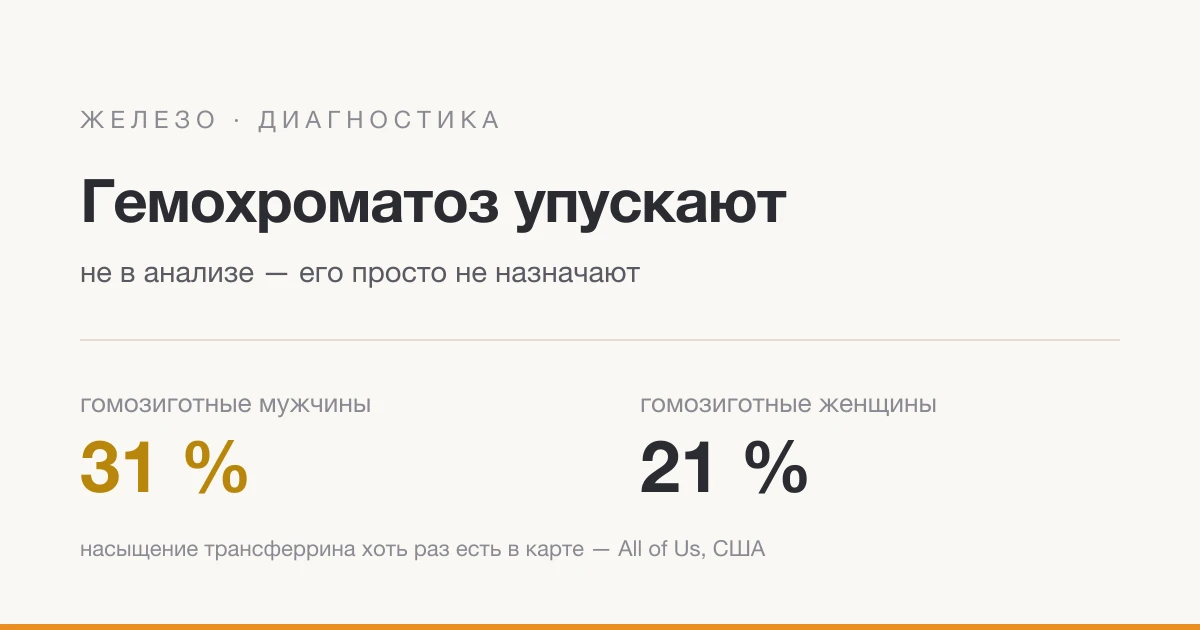
Haemochromatosis is not missed in the lab report — most often, the test is simply never ordered
Hereditary haemochromatosis is found late not because it is hard to recognise, but because the right test is most often never ordered. We look at data from large biobanks, at which two of the four iron markers actually detect the disease, and at who should have them checked first.
September 18, 2026
Ten healthy diets compared against biological age. The gap between them is smaller than it looks
German researchers took ten recognised healthy-eating scores — Mediterranean, DASH, MIND, Nordic and others — and matched them against epigenetic clocks in 6470 people. The interesting part is not which diet won, but two things the write-ups tend to drop.
September 17, 2026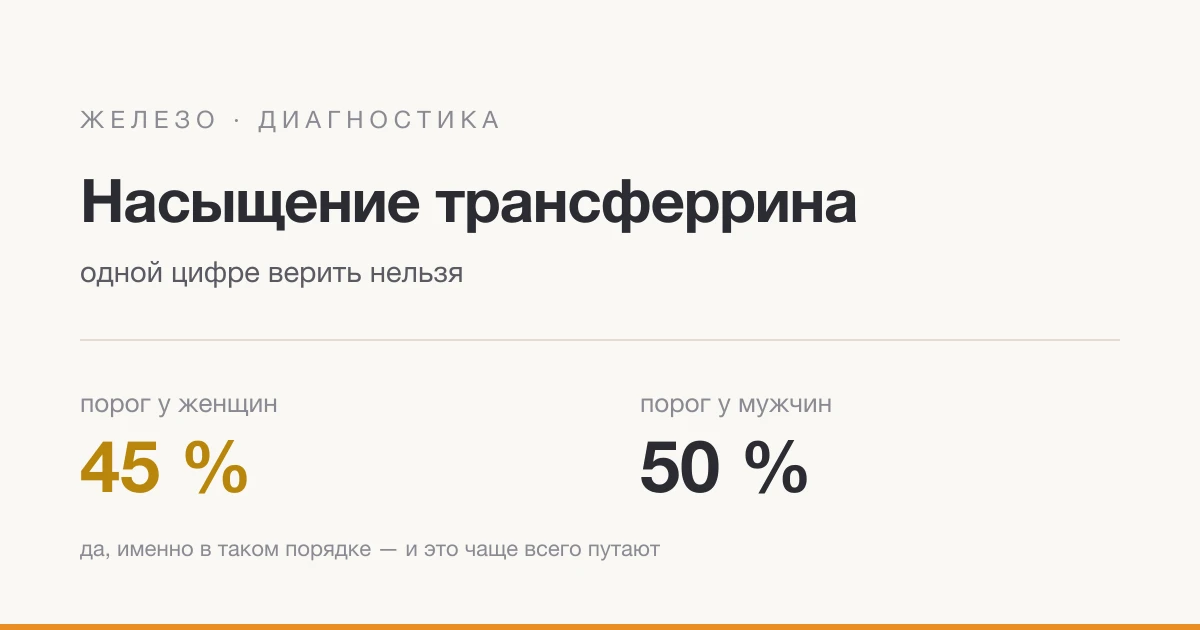
Transferrin saturation: why a single number cannot be trusted
A single high transferrin saturation is not a diagnosis, and not even grounds for genetic testing. In five short pages: what the number is made of, why it moves, where the real thresholds are, and what to do next.
September 17, 2026
Berberine for SIBO: first in the ranking, with nothing yet to compare it against
Berberine came first in a network meta-analysis of SIBO treatments — and that is true. But a ranking is not «it beat rifaximin»: no head-to-head comparison has been published, and one is running right now. What is actually shown, what the dose is in milligrams, and why safety matters more here than efficacy.
September 16, 2026SIBO: what the breath test shows, and why the order of steps matters more than the remedy
SIBO is both under-recognised and over-diagnosed, and the same breath test is responsible for each. What it actually measures and what it cannot do, why methane is not bacteria at all, where overgrowth comes from, and what a study found in thirty patients with brain fog — every one of whom was taking probiotics.
September 15, 2026Four systems worth watching
All four of the conditions people come with most often share one trait: they begin long before any complaint and give nothing away for years. So prevention is not a list of supplements. It is the habit of looking.
September 13, 2026Ready to start your health journey?
Book a consultation and receive a personalized treatment plan designed specifically for you by me personally.