The Most Common Endocrine Disorder in Women
Polycystic ovary syndrome (PCOS) affects 8-13% of reproductive-age women, making it the most prevalent endocrine disorder in women (Bozdag et al., Human Reproduction Update, 2016). Up to 70% of cases remain undiagnosed. The average time from symptom onset to diagnosis exceeds 2 years, with patients seeing an average of 3 physicians before receiving the correct diagnosis.
Rotterdam Criteria: Establishing the Diagnosis
PCOS is diagnosed when at least 2 of 3 criteria are present (Rotterdam Consensus, 2003):
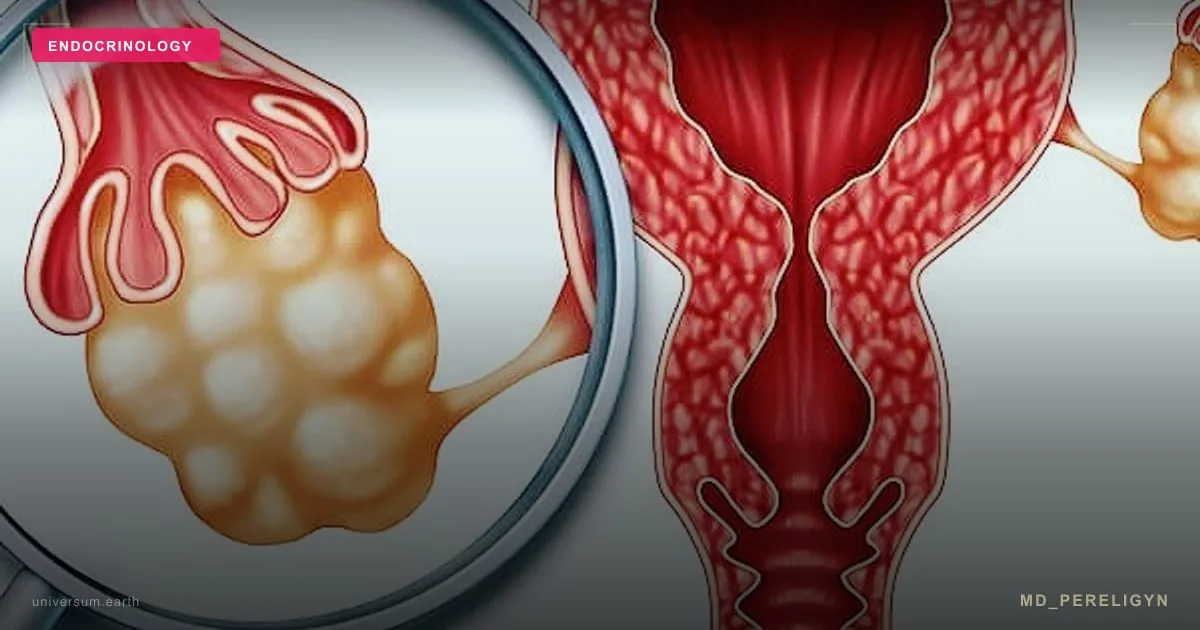
1. Oligo-ovulation or anovulation — irregular cycles (>35 days) or amenorrhea 2. Clinical and/or biochemical hyperandrogenism — acne, hirsutism, alopecia, elevated free testosterone or DHEA-S 3. Polycystic ovarian morphology on ultrasound — 12 or more follicles measuring 2-9 mm and/or ovarian volume >10 mL
Important: other causes of hyperandrogenism must be excluded — congenital adrenal hyperplasia (17-OH progesterone), Cushing syndrome (cortisol), prolactinoma (prolactin), hypothyroidism (TSH).
Insulin Resistance: The Root Cause in 70% of Patients
Insulin resistance is present in 70-80% of women with PCOS (both obese and lean). The mechanism: excess insulin stimulates ovarian theca cells to overproduce androgens (testosterone, androstenedione) and reduces SHBG, increasing bioavailable free testosterone.
Diagnostic workup for insulin resistance in PCOS: - Fasting insulin (>10 uIU/mL suspicious, >15 highly suggestive) - HOMA-IR index = glucose (mmol/L) x insulin (uIU/mL) / 22.5 (normal <2.0, PCOS often >3.0) - Oral glucose tolerance test (OGTT) with insulin — 0, 30, 60, 120 minutes - HbA1c — for chronic glycemia assessment
| Marker | Threshold |
|---|---|
| Fasting insulin | >10 uIU/mL suspicious, >15 highly suggestive |
| HOMA-IR | normal <2.0, often >3.0 in PCOS |
| AMH | elevated >4.7 ng/mL |
Anti-Mullerian Hormone (AMH): A PCOS Biomarker
AMH is produced by granulosa cells of preantral and small antral follicles. In PCOS, AMH is elevated 2-3 fold (>4.7 ng/mL) due to the large number of immature follicles. Dewailly et al. (Human Reproduction Update, 2014) proposed AMH as an additional diagnostic criterion.
Why Birth Control Does Not Solve the Problem
Combined oral contraceptives (COCs) are the standard first-line treatment in gynecological practice. They suppress ovarian androgens, regulate cycles, improve acne and hirsutism, and protect the endometrium.
However, COCs do NOT address insulin resistance. In fact, Diamanti-Kandarakis et al. (JCEM, 2003) showed that certain COCs worsen insulin resistance. Upon discontinuation, all symptoms return — often more severely.
Comprehensive PCOS Treatment Protocol
1. Inositol (Myo-inositol + D-chiro-inositol)
Myo-inositol (MI) is a second messenger in insulin signaling. MI deficiency is a key mechanism of insulin resistance in PCOS. Meta-analysis by Unfer et al. (Gynecological Endocrinology, 2017): MI 4,000 mg/day + DCI 110 mg/day (40:1 ratio) significantly reduces testosterone, improves ovulation, and lowers fasting insulin. Recommended: MI 2,000 mg + DCI 55 mg twice daily.
2. Metformin
An insulin sensitizer that reduces hepatic glucose production. Cochrane meta-analysis (Morley et al., 2017): metformin improves ovulation, reduces androgens, and decreases weight in PCOS. Starting dose: 500 mg, titrated to 1,500-2,000 mg/day.
3. Spironolactone
An aldosterone antagonist with anti-androgenic activity. Blocks androgen receptors and inhibits 5-alpha reductase. Dosage: 50-200 mg/day. Effects on acne and hirsutism appear after 3-6 months. Contraception is mandatory (teratogenic risk).
4. Lifestyle Management
Frequently Asked Questions
Can you get pregnant with PCOS? Yes. Correcting insulin resistance (inositol + metformin + lifestyle) restores ovulation in most women. If needed, letrozole is the preferred ovulation induction agent (superior to clomiphene per NEJM meta-analysis, 2014).
Is PCOS permanent? PCOS is a chronic condition with genetic predisposition. However, symptoms can be controlled and minimized by addressing insulin resistance.
Should PCOS be treated if pregnancy is not planned? Yes. Untreated PCOS increases risk of type 2 diabetes (5-8 fold), cardiovascular disease, endometrial hyperplasia and cancer, depression, and metabolic syndrome.
Is inositol better than metformin? Inositol is better tolerated (fewer GI side effects), available without prescription, and comparably effective. The optimal strategy is combining both.
This article is for educational purposes only and does not constitute medical advice. Always consult a qualified healthcare professional before starting any treatment.
🌀
Rotterdam Phenotypes: Four Subgroups Under One Diagnosis
The Rotterdam consensus defines PCOS by any two of three criteria, which mathematically yields four phenotypes. The 2023 International Evidence-Based Guideline endorses phenotype-specific risk stratification because metabolic burden differs substantially across subgroups.
Phenotype A (classic/full PCOS) combines hyperandrogenism, oligo-anovulation, and polycystic ovarian morphology. This is the most metabolically severe form. Prevalence of insulin resistance and metabolic syndrome is highest here, with HOMA-IR values typically above 3.5 and free androgen index elevations of 2-3 fold over controls [PMID: 24108622[1]].
Phenotype B has hyperandrogenism and oligo-anovulation without polycystic ovarian morphology on ultrasound. Metabolic risk approaches phenotype A. Patients in this group are frequently misdiagnosed as "not PCOS" because of normal-appearing ovaries on imaging, even though insulin resistance, dyslipidaemia, and androgen excess are fully present.
Phenotype C (ovulatory PCOS) combines hyperandrogenism with polycystic ovarian morphology but preserved regular ovulation. Metabolic risk is intermediate. Cycles are present, fertility may be normal, but acne, hirsutism, and androgenic alopecia drive clinical presentation. Spironolactone and combined oral contraceptives remain first-line; metformin and inositol are added when fasting insulin exceeds 10 μIU/mL or HOMA-IR exceeds 2.5.
Phenotype D (non-hyperandrogenic PCOS) combines oligo-anovulation with polycystic ovarian morphology but without clinical or biochemical hyperandrogenism. Metabolic risk is lowest and closest to controls. Some authors question whether phenotype D represents a distinct disorder from functional hypothalamic anovulation; differentiation requires ruling out energy deficit, hyperprolactinaemia, and thyroid dysfunction [PMID: 33729479[2]].
Clinical implication: insulin-targeted therapy (inositol, metformin, GLP-1 agonists) yields the largest absolute benefit in phenotypes A and B. Androgen-targeted therapy (spironolactone, combined oral contraceptives, finasteride) gives proportionally larger benefit in phenotype C. Phenotype D often responds to weight restoration and behavioural changes alone. Documenting the phenotype at diagnosis allows the patient and clinician to focus the therapeutic protocol rather than apply a generic PCOS template, and aligns laboratory follow-up with the dominant pathology — fasting insulin and HOMA-IR every 6-12 months for phenotypes A-B, free testosterone and SHBG for phenotype C, and cycle tracking with bone-density review for phenotype D when amenorrhoea persists.
🌀
Letrozole Protocol for Ovulation Induction
Letrozole, an aromatase inhibitor, replaced clomiphene citrate as the first-line ovulation induction agent in PCOS based on the 2014 NIH Pregnancy in Polycystic Ovary Syndrome II (PPCOS II) trial, which demonstrated higher live-birth rates (27.5% vs 19.1%) and higher cumulative ovulation rates with letrozole. The 2023 international guideline now lists letrozole as recommended first-line and clomiphene as alternative.
🌀
Endometrial Protection and Surveillance
Chronic anovulation produces unopposed oestrogen exposure of the endometrium. Without periodic progestin opposition, the endometrium undergoes proliferation, then complex hyperplasia, then in some patients endometrial carcinoma. Women with PCOS have a 2.7-fold increased risk of endometrial carcinoma compared with the general population [PMID: 23335732[4]].
Progestin regimens (when contraception is not desired). Cyclic micronised progesterone 200 mg orally at bedtime for 12-14 days every 1-3 months induces a predictable withdrawal bleed. Medroxyprogesterone acetate 10 mg daily for 10-14 days is an alternative. The levonorgestrel-releasing intrauterine system (52 mg, 8-year duration) provides continuous endometrial protection and is the preferred long-term option for patients with abnormal uterine bleeding plus anovulatory PCOS [PMID: 34325430[5]].
🌀
Adolescent PCOS: Why Adult Criteria Misclassify
Adolescent PCOS diagnosis is the most frequent source of overdiagnosis in endocrine practice. The Rotterdam ultrasound criterion (12+ follicles 2-9 mm, ovarian volume >10 mL) overlaps almost completely with normal post-menarchal ovarian appearance, where multifollicular ovaries are physiological for 2-3 years after first menses.
The 2017 international adolescent PCOS criteria, reaffirmed in 2023, require both persistent oligo-anovulation and clinical or biochemical hyperandrogenism, and explicitly exclude ultrasound from the diagnostic criteria within eight years of menarche [PMID: 17609215[7]].
References
Key facts
- Diagnosis needs 2 of 3 Rotterdam criteria: oligo/anovulation, hyperandrogenism, polycystic morphology (12+ follicles, ovary >10 mL).
- Insulin resistance affects 70-80% of women with PCOS; excess insulin drives ovarian androgens and lowers SHBG.
- HOMA-IR = glucose × insulin / 22.5; normal <2.0, often >3.0 in PCOS. Fasting insulin >10 uIU/mL is suspicious.
- Inositol: myo-inositol 4,000 mg + D-chiro-inositol 110 mg/day (40:1) lowers testosterone and fasting insulin.
- COCs mask symptoms but do not address insulin resistance; symptoms return after discontinuation.