Introduction: Iodine Does Not Work in Isolation
The standard approach to thyroid health — "take some iodine" — ignores a key principle of endocrinology: iodine acts not on its own, but within a system of cofactors. Without a properly tuned system, iodine does not heal — it fuels inflammation, especially in patients with pre-existing autoimmune thyroiditis (Hashimoto).
This article breaks down five levels through which iodine passes from absorption to active T3 hormone production — and how each can become a bottleneck.
🌀
Stage 1: Cellular Uptake (NIS)
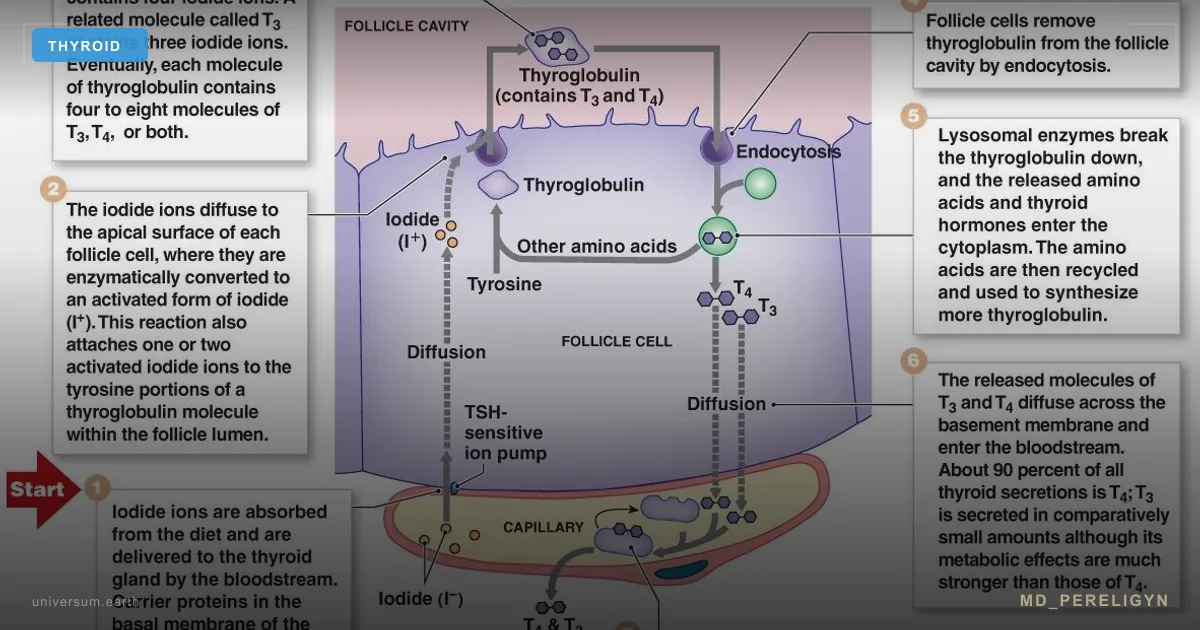
Iodine must not just enter the body — it must enter the thyroid cell via the sodium-iodide symporter (NIS), a thyrocyte membrane protein.
This requires:
▸Normal sodium-potassium gradient — basis of symporter function ▸Cellular energy — ATP for active transport ▸Living, non-inflamed tissue — NIS is dysfunctional in thyroiditis
What helps:
Avoid burnout, chronic stress, and starvation. Maintain nutrition and cellular energy. Fasting — especially prolonged — reduces NIS expression, explaining why women on aggressive diets often develop functional "hypothyroidism" with normal thyroids.
Nutraceuticals: magnesium 300–400 mg, electrolytes/quality salt, adequate protein (1.2–1.5 g/kg).
🌀
Stage 2: Thyroid Peroxidase (TPO)
Without thyroid peroxidase (TPO), iodine will not oxidize and incorporate into hormones. This enzyme converts iodide (I⁻) into the active form ready for inclusion in thyroglobulin.
Two common bottlenecks here: autoimmune thyroiditis (Hashimoto) and iron deficiency:
▸TPO antibodies (anti-TPO) in Hashimoto block the enzyme ▸Iron is a TPO cofactor. Without iron-dependent synthesis, TPO does not function
What helps:
▸Check ferritin (target 70–100 ng/mL, not "normal range") ▸Do not give iodine blindly with positive anti-TPO — this pours fuel on fire
Nutraceuticals: iron (if ferritin < 70 — bisglycinate 25–50 mg), address causes of iron deficiency (low gastric acidity, Helicobacter, blood loss), vitamin C 500 mg for absorption. Anti-TPO reduction work — selenium + vitamin D + anti-inflammatory diet.
🌀
Stage 3: Peroxide Protection
This is the most underestimated stage. When iodine is processed, the thyroid generates hydrogen peroxide (H₂O₂) — needed for iodine oxidation. But peroxide is toxic to the tissue itself.
Peroxide is fire: the kind that warms and the kind you can cook on. Without peroxide, hormones are not assembled. But without selenium, the fire goes out of control.
Selenium is the fire extinguisher. It enters glutathione peroxidase and instantly quenches excess peroxide. Without selenium, iodine does not help — it only worsens inflammation and autoimmunity.
This explains a common phenomenon: Hashimoto patients take "iodine" and 6 months later return with higher antibodies and nodules. Their "treatment" works against them.
What helps:
▸Do not start iodine during active inflammation or burnout ▸First restore the antioxidant system
Nutraceuticals: selenium 100–200 µg/day (for 2–4 weeks before starting iodine), NAC 600–1200 mg, glycine 3 g, vitamin C 500–1000 mg.
🌀
Stage 4: Iodine + Iodide (Form Balance)
Iodine exists in two forms:
▸Iodide (I⁻) — simple ionic form, absorbs in GI, goes to thyroid ▸Molecular iodine (I₂) — complex form, predominantly used by mammary gland and other tissues
Supplements contain different ratios. Lugol's solution — classic combination. Potassium iodide (KI) — iodide only.
Iodine is needed, but if poured in without selenium, iron, and proper environment, it can do harm. Iodine + iodide work in the context of the whole system. Without cofactor preparation, even "correct" Lugol can worsen autoimmune thyroiditis.
md_pereligyn principle:
1. Labs first (TSH, fT4, fT3, anti-TPO, anti-Tg, ferritin, RBC selenium, vitamin D) 2. Cofactor preparation (selenium, iron, antioxidants) for 4–8 weeks 3. Only then iodine — starting with microdoses and gradually increasing 4. Recheck at 8–12 weeks: antibodies, TSH, fT3
🌀
Stage 5: T4 → T3 Conversion
This is where it is decided whether you have energy or just "normal T4" in labs. The final and most important stage.
T4 is a "prohormone", weak on its own. T3 is active, powerful. T4 → T3 conversion happens in tissues via deiodinase enzymes (D1, D2) which require selenium.
Conversion is broken by:
▸Starvation (prolonged caloric deficit) ▸Inflammation (elevated CRP) ▸Liver — most conversion happens in liver; fatty liver disease kills it ▸Gut — 20% of conversion happens in gut, requires healthy microbiome ▸Deficiencies of selenium, zinc, iron
When conversion is broken, labs show "normal T4 + low fT3 + high reverse T3 (rT3)" — clinical hypothyroidism with "normal labs". This is missed if fT3 is not checked. Detailed breakdown of the rT3 trap and survival mode — in Weight loss and reverse T3.
What helps:
▸Stop fasting (prolonged deficit breaks D2) ▸Sleep 7–9 hours ▸Adequate protein (1.2–1.5 g/kg) ▸Support bile (ox bile, taurine) ▸Restore gut (butyrate, probiotics) ▸Reduce chronic stress (cortisol suppresses D2)
Nutraceuticals: selenium 200 µg, zinc 15–25 mg, magnesium 300–400 mg, omega-3 EPA/DHA 1–2 g, tyrosine 500 mg morning.
🌀
Summary: Five-Stage Check Before Iodine
Before starting iodine-containing supplements — especially in patients with autoimmune thyroiditis — verify all five stages:
| Stage | What is needed | Marker | |-------|----------------|--------| | 1. Cellular uptake (NIS) | Energy, no burnout | Cortisol, nutrition, protein | | 2. TPO | Iron, no active autoimmunity | Ferritin 70–100, anti-TPO | | 3. Peroxide protection | Selenium, antioxidants | RBC selenium, GSH | | 4. Iodine+iodide balance | Cofactor preparation | Full panel | | 5. T4→T3 conversion | Selenium, zinc, liver, gut | fT3, rT3, liver panel |
If even one stage is dysfunctional — iodine will not help. Worst case: a Hashimoto patient starts iodine without selenium and triggers autoimmune flare.
🌀
Principle
Iodine is raw material — but very important raw material. Without a protective system (selenium + iron + antioxidants), you are not treating — you are feeding autoimmunity, nodules, and hyperfunction.
Modern endocrinology (American Thyroid Association, 2017) recommends a differentiated approach: iodine indicated for confirmed deficiency (urinary iodine, regional epidemiology) and not indicated for Hashimoto without deficiency. Global iodine prophylaxis via iodized salt is a population-level measure, not individual.
Individual therapy requires diagnostics and preparation. "Everyone takes iodine — so should you" is not clinical medicine.
🌀
Conclusion
Iodine is an essential element for thyroid hormone synthesis. But isolated supplementation without assessing the cofactor system often worsens autoimmune inflammation and nodular changes, especially in Hashimoto.
The correct approach: full diagnostics → system preparation (selenium, iron, antioxidants) → gradual iodine introduction with antibody and function monitoring → reassessment at 8–12 weeks. This is the path from "protocol-based treatment" to personalized endocrinology.
---
References:
- Pearce EN et al. *Iodine intake in the United States.* PMID 24506123 (population data)
- Köhrle J. *Selenium and the thyroid.* PMID 15971115 (selenium-thyroid interaction)
- Toulis KA et al. *Selenium supplementation in autoimmune thyroiditis.* PMID 20230891 (meta-analysis)
- Alexander EK et al. *2017 Guidelines of the American Thyroid Association for Diagnosis and Management of Thyroid Disease During Pregnancy.* PMID 28056690
🌀
Lugol's Solution: Composition, Per-Drop Dosing, and Why the Ratio Matters
The article references "Iodine + Iodide (Form Balance)" in Stage 4 but does not specify the pharmaceutical formulation most commonly used to deliver both species simultaneously. Lugol's solution, first described by Jean Lugol in 1829, is an aqueous solution containing molecular iodine (I₂) and potassium iodide (KI) in a fixed 1:2 ratio by mass, with potassium iodide acting as a solubilizer for the otherwise poorly water-soluble I₂.
Standard 5% Lugol's contains 5 g iodine and 10 g potassium iodide per 100 mL, delivering approximately 6.25 mg of total elemental iodine per drop (2.5 mg I₂ + 3.75 mg iodide from KI). The 2% formulation delivers 2.5 mg per drop, and the 7% formulation delivers 8.75 mg per drop. These doses are 40 to 60 times higher than the WHO recommended daily intake of 150 µg for non-pregnant adults, which explains why uncontrolled Lugol's supplementation in untreated autoimmune thyroiditis is a documented precipitant of clinical hypothyroidism PMID: 16551710.
The dual-form rationale relates to differential tissue uptake. The sodium-iodide symporter (NIS) transports iodide (I⁻), making KI the substrate for thyroidal trapping. Molecular I₂, by contrast, demonstrates preferential uptake in mammary, gastric, and prostatic tissue via mechanisms independent of NIS, including a putative I₂-specific transporter and direct diffusion PMID: 16484575. Studies in fibrocystic breast disease have shown symptomatic improvement with molecular I₂ but not with KI alone, supporting form-specific extrathyroidal effects PMID: 9024235.
Practical conversion: a drop of 5% Lugol's (6.25 mg) exceeds the 1.1 mg tolerable upper intake level (UL) established by the U.S. Institute of Medicine for adults. Doses above the UL should not be self-administered without baseline TSH, anti-TPO, anti-Tg, and urinary iodine measurement, and should not be initiated in the presence of nodular goiter, latent hyperthyroidism (suppressed TSH with normal hormones), or active Hashimoto's flare. The "saturation" protocols popularized in lay literature (12.5–50 mg daily) lack supporting randomized evidence and have produced documented cases of iodine-induced hypothyroidism and thyrotoxicosis in surveillance series PMID: 16551710, PMID: 28332406.
🌀
Iodine-Induced Autoimmune Flare and the Jod-Basedow Phenomenon
The protocol references the risk of autoimmune activation but does not describe the underlying immunology. Two distinct adverse phenomena are documented with iodine repletion in predisposed individuals.
The first is iodine-induced exacerbation of Hashimoto's thyroiditis. Excess iodide entering the follicular cell increases the iodination density of thyroglobulin (Tg). Highly iodinated Tg is more antigenic than poorly iodinated Tg, producing neo-epitopes recognized by autoreactive T cells PMID: 21745628. In parallel, supraphysiologic iodide concentrations transiently inhibit thyroid peroxidase via the acute Wolff-Chaikoff effect, but in individuals with pre-existing TPO antibody-driven peroxide dysregulation, the recovery (escape) phase is impaired, producing sustained hormone deficit. Population surveys following salt iodization in previously iodine-deficient regions have demonstrated a 2- to 4-fold rise in anti-TPO seroprevalence and clinical hypothyroidism within 5 to 10 years, particularly in genetically susceptible cohorts PMID: 24026378, PMID: 16551710.
The second phenomenon is Jod-Basedow thyrotoxicosis, in which iodine exposure precipitates hyperthyroidism in patients with autonomous nodules or latent Graves' disease. The mechanism is straightforward: autonomously functioning follicles are not subject to TSH-mediated negative feedback, and additional iodide substrate increases hormone synthesis without compensatory downregulation. Risk is highest in older adults with multinodular goiter living in formerly iodine-deficient regions, with reported incidence of 1–2% following iodinated contrast administration in this group PMID: 28293077.
Practical screening before iodine supplementation in the dosage ranges discussed in this article: TSH, fT4, fT3, anti-TPO, anti-Tg, and thyroid ultrasound to exclude autonomous nodules. A suppressed TSH (<0.4 mIU/L) or anti-TPO titer above the laboratory upper reference limit are relative contraindications to milligram-range iodine, and absolute contraindications to "saturation" protocols. In the presence of established Hashimoto's, the upper safe ceiling is the WHO recommended dietary allowance (150 µg adults, 220 µg pregnancy, 290 µg lactation), with monitoring of TSH and anti-TPO at 8 and 16 weeks after any intake change.
🌀
Urinary Iodine Concentration: Reference Ranges and Interpretation
Urinary iodine is listed as a biomarker in the article but without the population-based cut-points required for clinical use. Because approximately 90% of dietary iodine is excreted renally within 24–48 hours, urinary iodine concentration (UIC) reflects recent intake and is the WHO-endorsed indicator of population and individual iodine status PMID: 25266247.
WHO epidemiological criteria for spot UIC in non-pregnant adults: insufficient <100 µg/L, adequate 100–199 µg/L, more than adequate 200–299 µg/L, and excessive ≥300 µg/L. For pregnancy, the adequate range is 150–249 µg/L, with insufficient <150 µg/L. For lactating women and children under 2 years, the adequate threshold is ≥100 µg/L, recognizing that lactation transfers iodine to milk PMID: 25266247.
Two methodological caveats are essential. First, spot urine UIC has high day-to-day variability in individuals (coefficient of variation 30–60%), so a single measurement cannot reliably classify one patient; serial samples or a 24-hour collection are required for individual diagnosis PMID: 28319109. Second, the urinary iodine-to-creatinine ratio (µg iodine per g creatinine) corrects for hydration status and is preferred over raw concentration in patients with extreme fluid intake or low muscle mass; the adequate ratio in adults is approximately 100–200 µg/g PMID: 28333944.
Excess UIC (≥300 µg/L sustained, or ≥500 µg/L on any sample) warrants attention even in asymptomatic patients, as longitudinal data link chronic excess to increased anti-TPO incidence and overt hypothyroidism risk, particularly in genetically susceptible individuals PMID: 24026378. Within Stage 4 of the protocol described in the body, urinary iodine measured 4–6 weeks after dose initiation is the most informative single marker for confirming that supplementation has moved a patient out of deficiency without entering the excess range.
🌀
Pregnancy and Lactation: Iodine Requirements Outside the Adult Protocol
The five-stage protocol addresses non-pregnant adults; iodine requirements in pregnancy and lactation are categorically different and warrant explicit recognition because the consequences of both deficiency and excess in this window are non-recoverable for the fetus.
The maternal thyroid increases hormone production by approximately 50% during the first trimester to supply the fetus until its own thyroid becomes functional at gestational weeks 18–20. Renal iodine clearance also rises by 30–50%. The combined effect raises the daily iodine requirement from 150 µg (non-pregnant) to 220 µg (pregnancy) and 290 µg (lactation) per WHO and Endocrine Society guidance PMID: 11932302. Moderate-to-severe iodine deficiency during pregnancy is the most common preventable cause of intellectual disability worldwide, with even mild deficiency (UIC 50–149 µg/L) associated with reduced offspring IQ by 6–10 points in cohort studies PMID: 22319561.
Supplementation in this context should not exceed 250 µg per day of total iodine (diet plus supplement). Doses above this threshold during pregnancy have been associated with neonatal hypothyroidism via fetal Wolff-Chaikoff effect, which the immature thyroid cannot escape until approximately week 36 of gestation PMID: 16551710. The implication is direct: the milligram-range Lugol's protocols discussed earlier are contraindicated in pregnancy and lactation. Prenatal vitamins should be selected for verified iodine content (150 µg as potassium iodide is the standard formulation), since up to half of U.S. prenatal products historically contained less than the labeled amount or no iodine PMID: 22319561.
Postpartum, the lactating mother is the sole iodine source for the exclusively breastfed infant. Maternal supplementation at 200–290 µg/day maintains breast milk iodine concentrations in the adequate range (100–200 µg/L), supporting infant thyroid hormone synthesis during the neurologically critical first six months PMID: 11932302.
References
- PMID 24506123. PMID 24506123
- PMID 15971115. PMID 15971115
- PMID 20230891. PMID 20230891
- PMID 28056690. PMID 28056690
- PMID: 16551710. PMID 16551710
- PMID: 16484575. PMID 16484575
- PMID: 9024235. PMID 9024235
- PMID: 28332406. PMID 28332406
- PMID: 21745628. PMID 21745628
- PMID: 24026378. PMID 24026378
- PMID: 28293077. PMID 28293077
- PMID: 25266247. PMID 25266247
- PMID: 28319109. PMID 28319109
- PMID: 28333944. PMID 28333944
- PMID: 11932302. PMID 11932302
- PMID: 22319561. PMID 22319561